32 Frontiers and Synthesis
The future arrives unevenly, and faster than we expect.
Estimated reading time: 20-30 minutes
Prerequisites: This capstone chapter synthesizes material from the entire book. Readers should be familiar with foundation model architectures (Part III), multi-modal integration approaches (Part IV), and responsible deployment considerations (Part V). Key background includes uncertainty quantification (Chapter 24), interpretability (Chapter 25), causal inference (Chapter 26), and regulatory governance (Chapter 27).
Learning Objectives: After completing this chapter, you should be able to:
- Identify the three major open technical challenges limiting genomic foundation model impact
- Evaluate emerging directions (multimodal architectures, agentic systems, and learning health systems) in terms of both promise and risk
- Articulate why capability and trustworthiness are both necessary for clinical translation
- Assess specific technical bottlenecks (scaling, multi-scale integration, causality) in their research or application context
- Synthesize the themes from preceding chapters into a framework for evaluating future developments
Key Insight: The gap between a model that predicts well on benchmarks and a patient who benefits from better care encompasses not just technical challenges but the full complexity of clinical translation: validation, workflow integration, equitable access, and ongoing governance.
Your Role: Whether you are developing new models, deploying existing ones in clinical settings, or evaluating claims from the research literature, you will shape how this field evolves. The frameworks in this chapter equip you to distinguish genuine advances from hype, identify which technical bottlenecks matter for your application, and contribute to responsible translation. The field needs practitioners who can bridge technical capability and clinical impact, and that is precisely what this book has prepared you to become.
In 2019, predicting protein structure from sequence alone seemed decades away. By 2024, AlphaFold had rendered it essentially solved. In 2020, generating coherent paragraphs of text required specialized tuning; by 2025, language models could write, code, and reason across domains with minimal prompting. These discontinuous advances suggest that the genomic foundation models surveyed in this book may be on the cusp of capabilities we cannot fully anticipate, capabilities that might reshape clinical genetics, drug discovery, and our understanding of human biology, though the pathway from research capability to clinical impact remains uncertain and historically takes longer than researchers expect.
Yet predicting when matters less than preparing for what. The gap between a model that performs well on benchmarks and a patient who benefits from better care encompasses not just technical challenges but the full complexity of clinical translation: validation, workflow integration, equitable access, and ongoing governance. This final chapter examines the technical problems that remain unsolved, the emerging directions that may address them, and the path from research capabilities to clinical impact.
32.1 Open Technical Problems
The technical challenges surveyed in preceding chapters remain only partially solved. Foundation models for genomics have demonstrated substantial capabilities in benchmark evaluations, but they operate far below theoretical limits and fail in ways that better architectures, training strategies, or data might address, though which improvements will translate to clinical impact remains uncertain. Three challenges stand out as particularly important for the field’s trajectory: scaling models to capture biological complexity, integrating information across biological scales, and moving from correlation to causal and mechanistic understanding. Progress on any of these fronts would unlock applications currently beyond reach.
Before reading about specific technical challenges, reflect on your own experience with genomic models (or machine learning models more broadly): What are the most frustrating limitations you have encountered? Are they due to insufficient model capacity, wrong training data, inappropriate evaluation, or something else entirely? Keep your answer in mind as you read this section.
32.1.1 Scaling and Efficiency
The largest foundation models in natural language processing now exceed a trillion parameters and were trained on trillions of tokens (Fedus, Zoph, and Shazeer 2022; Chowdhery et al. 2022). Genomic foundation models remain substantially smaller, with typical models ranging from hundreds of millions to low billions of parameters. Whether genomic applications require comparable scale remains uncertain. The human genome spans 3 billion base pairs and encompasses perhaps 20,000 protein-coding genes, a smaller and more constrained space than natural language. But capturing the full complexity of gene regulation, protein structure, and cellular context may require parameter counts that approach or exceed language model scale.
Scaling genomic foundation models faces several bottlenecks. Training data availability constrains scale when models exhaust unique sequences and must rely on data augmentation or repetition. Compute costs remain prohibitive for most academic groups and limit experimentation with truly large architectures. Long sequence lengths required for genomic context (regulatory elements can span hundreds of kilobases) create quadratic attention costs that limit practical context windows despite architectural innovations (see Chapter 7).
Before examining the table below, predict: What are the three or four major bottlenecks limiting genomic foundation model scaling, and what approaches might address each? Write down your predictions, then compare with Table 32.1.
The four major bottlenecks are: (1) Training data - finite unique genomes, addressed through multi-species pretraining and synthetic data; (2) Compute cost - trillion-parameter models cost $10M+, addressed through sparse attention and distillation; (3) Context length - quadratic attention limits practical windows, addressed through linear-time architectures; (4) Evaluation - benchmarks saturate before biological problems solved, requiring task-specific validation. Each bottleneck requires different solutions trading off different constraints.
| Bottleneck | Current State | Potential Solutions |
|---|---|---|
| Training data | Finite unique genomes (~100k species with assemblies) | Multi-species pretraining, synthetic data, data augmentation |
| Compute cost | Trillion-parameter models cost $10M+ to train | Sparse attention, state space models, knowledge distillation |
| Context length | Quadratic cost limits practical windows to ~100kb | Linear-time architectures (Mamba), chunking strategies |
| Evaluation | Benchmarks saturate before biological problems solved | Task-specific evaluation, clinical validation |
How does model scale affect variant effect prediction performance? Data from multiple DNA language models illustrates diminishing returns:
| Model | Parameters | ClinVar missense AUC | Training compute (GPU-hours) |
|---|---|---|---|
| DNABERT-S | 110M | 0.78 | ~1,000 |
| Nucleotide Transformer | 500M | 0.82 | ~10,000 |
| Nucleotide Transformer | 2.5B | 0.84 | ~50,000 |
| HyenaDNA (long context) | 1.4B | 0.83 | ~40,000 |
| Evo (multispecies) | 7B | 0.85 | ~200,000 |
Key observations:
Diminishing returns: Moving from 110M to 500M parameters improves AUC by 0.04 (5× compute). Moving from 500M to 2.5B improves AUC by only 0.02 (5× compute). The marginal benefit per compute dollar decreases.
Architecture matters more than scale: HyenaDNA at 1.4B with long-context architecture achieves comparable performance to NT-2.5B with standard attention, suggesting architectural innovation may be more cost-effective than raw scaling.
Task ceiling: All models plateau around 0.85 AUC on this benchmark, suggesting performance may be limited by label noise in ClinVar rather than model capacity.
Cross-species transfer helps: Evo’s multispecies pretraining achieves highest performance, suggesting data diversity matters alongside model size.
This pattern (diminishing returns with a task-dependent ceiling) differs from language model scaling laws where performance continues improving with scale. Genomic tasks may have lower information density or more fundamental data limitations.
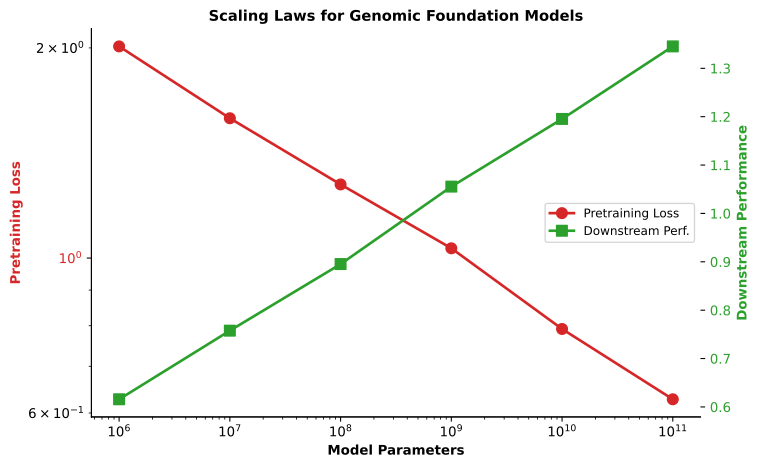
Efficiency improvements that reduce compute requirements without sacrificing capability are thus particularly valuable for genomic applications. Approaches include sparse attention patterns that avoid full quadratic costs, state space models that process sequences in linear time (Gu and Dao 2024), knowledge distillation that transfers capability from large models to smaller ones, and quantization that reduces precision requirements for inference (see Appendix B). Sparse attention achieves efficiency by computing attention only between nearby tokens or predetermined patterns rather than all pairs, reducing complexity from O(n^2) to O(n) or O(n log n) at the cost of limiting which long-range dependencies can be captured. State space models replace attention entirely with recurrent computations that maintain a fixed-size hidden state, enabling linear-time processing but requiring the model to compress all relevant context into that finite state. Knowledge distillation trains a smaller “student” model to match the outputs of a larger “teacher,” preserving much of the teacher’s capability in a more deployable form. Each approach involves trade-offs between efficiency gains and capability preservation that must be evaluated empirically on genomic tasks.
Pause the scaling discussion for a moment. From Chapter 7, what is the time complexity of standard self-attention for a sequence of length n? Why does this create particular challenges for genomic sequences compared to typical language model inputs? How might this relate to the bottlenecks just discussed?
Standard self-attention has O(n²) time and memory complexity because it computes attention scores between all pairs of tokens. This creates severe challenges for genomic sequences because regulatory elements can span hundreds of kilobases, far exceeding typical language model context windows (which handle thousands of tokens). For a 100kb sequence, quadratic scaling becomes prohibitive. This directly relates to the “context length” bottleneck: the biological context needed (enhancers acting on distant promoters) exceeds what standard attention can efficiently process, motivating linear-time alternatives like Mamba.
The scaling laws that govern language models may not directly transfer to genomic applications. Genomic sequences have different statistical properties (lower entropy, stronger long-range dependencies, reverse-complement symmetry), and biological function imposes constraints absent in natural language. A model that memorizes more of the genome is not necessarily better at predicting variant effects or gene regulation. The key question is not “how big?” but “what capabilities emerge at what scale for which tasks?”
Before proceeding to multi-scale integration, ensure you understand:
- The four major bottlenecks to scaling genomic foundation models (data, compute, context, evaluation)
- Why scaling laws from language models may not transfer to genomic applications
- Efficiency approaches (sparse attention, state space models, distillation) and their tradeoffs
If these concepts are unclear, review the preceding sections before continuing.
32.1.2 Context and Multi-Scale Integration
Biological phenomena span scales from nucleotides to ecosystems. Foundation models must integrate information across these scales to capture biological reality: local sequence motifs, regulatory element architecture, chromosome-level organization, cellular context, tissue environment, organism-level physiology, and population-level variation all contribute to genotype-phenotype relationships.
Current approaches typically focus on single scales or model multi-scale relationships implicitly through large training datasets rather than explicitly through architectural design. A DNA language model processes sequence tokens without explicit representation of chromatin structure. A single-cell model embeds cells without explicit representation of tissue organization. A regulatory model predicts expression without explicit representation of 3D genome contacts.
Before reading further about multi-scale integration, retrieve what you learned earlier about scaling. From the discussion ~20 lines above, what were the four major bottlenecks to scaling genomic foundation models? Can you explain in your own words why “bigger” is not automatically “better” for genomic applications?
The four bottlenecks are: (1) training data (finite unique genomes), (2) compute cost (prohibitive for trillion-parameter models), (3) context length (quadratic attention limits practical windows), and (4) evaluation (benchmarks can saturate). “Bigger” is not automatically better because genomic sequences have fundamentally different properties than language (lower entropy, stronger long-range dependencies, reverse-complement symmetry), and biological function imposes constraints absent in natural language. Simply memorizing more genome sequence does not guarantee better variant effect prediction or regulatory understanding; the key question is what capabilities emerge at what scale for which specific tasks.
Can you map each of the following model types to the scale(s) they primarily operate at? (1) ESM-2, (2) Enformer, (3) scGPT, (4) Akita, (5) AlphaMissense
Hint: Review the model taxonomy from Section 14.5 and the specific model chapters if needed.
- ESM-2: Protein sequence/structure scale (amino acid level)
- Enformer: Regulatory element scale (kilobase DNA sequences predicting gene expression)
- scGPT: Single-cell scale (cellular gene expression states)
- Akita: Chromosome-scale (3D genome organization and chromatin contacts)
- AlphaMissense: Protein variant scale (missense mutation effects on protein function)
Each excels at its primary scale but does not explicitly integrate across scales.
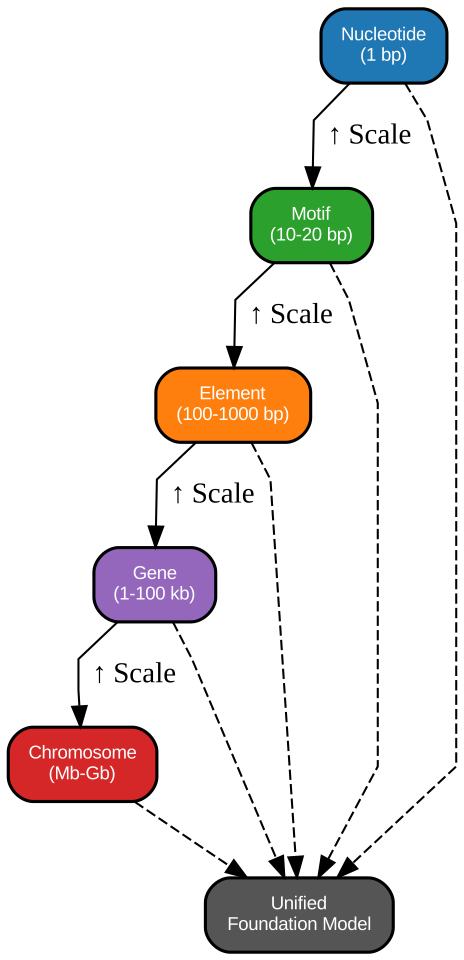
Architectures that explicitly integrate across scales remain a frontier. Hierarchical models that compose representations at different resolutions, graph neural networks that encode biological relationships across scales (Section 22.2.2), and hybrid systems that combine modality-specific encoders with cross-modal attention layers all represent active research directions.
Why is multi-scale integration fundamentally harder than single-scale modeling? The challenge is not merely computational but conceptual: the rules governing each scale differ qualitatively. Nucleotide-level models learn sequence motifs through local correlations; these patterns are dense, stationary, and amenable to convolutional architectures. Cell-level models learn regulatory programs through gene co-expression; these relationships are sparse, context-dependent, and require attention or graph structures. Tissue-level models learn spatial organization through cell-cell interactions; these patterns are geometric and require architectures that respect physical locality. No single architecture naturally spans these diverse statistical structures. A model that excels at motif detection may fail at capturing cell-state transitions; a model that captures tissue organization may be blind to the sequence features that drive it. True multi-scale integration requires not just concatenating representations but learning how perturbations propagate across scales: how a single nucleotide change becomes a protein misfolding becomes a cellular stress response becomes a tissue pathology. This causal chain crosses multiple levels of biological organization, each with its own dynamics and timescales.
The APOE ε4 allele (rs429358 C→T, resulting in Cys→Arg at position 112) illustrates how molecular perturbations propagate across biological scales to produce disease:
| Scale | Observation | Model Type Needed |
|---|---|---|
| Sequence | Single C→T substitution in APOE exon 4 | DNA-LM / VEP |
| Protein | Arg112 disrupts salt bridge with Glu255, destabilizing lipid-binding domain | ESM-2 / AlphaFold |
| Cellular | Reduced lipid clearance by astrocytes; impaired Aβ degradation by microglia | Single-cell models |
| Tissue | Increased amyloid plaque deposition in hippocampus and cortex | Spatial transcriptomics models |
| Organism | 3-15× increased Alzheimer’s risk; earlier onset by ~7 years | Clinical risk models |
The multi-scale integration challenge:
Current models excel at individual scales. AlphaMissense correctly predicts ε4 as pathogenic (score: 0.92). ESMFold captures the structural destabilization. scGPT identifies the affected cell types. But no existing model traces the complete causal chain from the single nucleotide change through protein misfolding → lipid dysregulation → cellular stress → tissue pathology → disease.
A true multi-scale foundation model would take the sequence variant as input and output predictions at each scale: structural impact (0.85), cellular consequence (lipid metabolism disruption in astrocytes), tissue effect (hippocampal vulnerability), and clinical risk (OR = 3.2 for AD by age 75). This requires not just concatenating predictions but learning the causal propagation rules that connect scales.
Success will require not just architectural innovation but appropriate training data that captures multi-scale relationships and evaluation protocols that probe multi-scale reasoning.
32.1.3 Causality and Mechanism
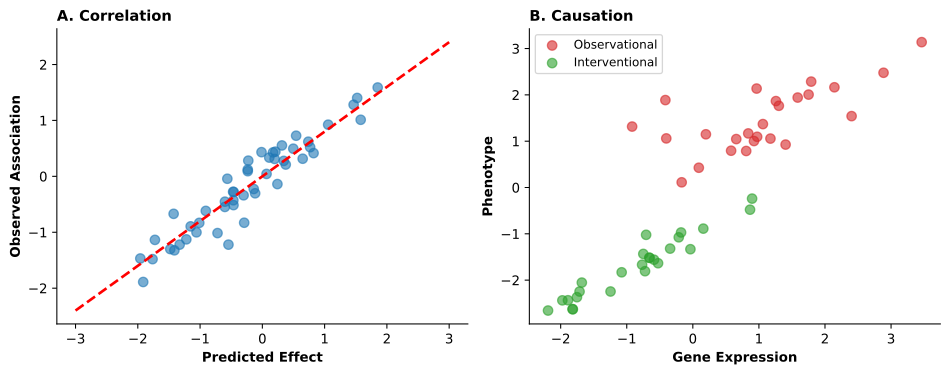
The distinction between correlation and causation pervades genomic analysis. A variant associated with disease in genome-wide association study (GWAS) may be causal, in linkage disequilibrium with a causal variant, or confounded by population structure or other factors (Section 3.3). A regulatory element predicted to affect expression may directly drive transcription or may merely co-occur with other causal elements. Foundation models, like other statistical learners, capture patterns in training data without distinguishing causal from correlational relationships.
Foundation models learn statistical associations from data. When a DNA language model assigns high likelihood to a sequence, it indicates the sequence is consistent with patterns in the training corpus, not that the sequence functions in any particular way. When a variant effect predictor scores a mutation as deleterious, it reflects features associated with pathogenic variants in training data, not necessarily the causal mechanism of pathogenicity. This distinction, discussed in detail in Chapter 26, remains the central limitation for applications requiring mechanistic understanding.
Progress toward causal and mechanistic reasoning in genomic AI likely requires integrating diverse evidence types. Perturbation experiments (CRISPR knockouts, drug treatments, environmental exposures) provide interventional data that can distinguish causal effects from correlations. Mendelian randomization approaches leverage genetic instruments to estimate causal effects from observational data (Davey Smith and Ebrahim 2003). Structural causal models provide formal frameworks for encoding and reasoning about causal relationships.
Chapter 25 covered causal inference in depth. Before examining the table below, retrieve from memory: What are the three main approaches to causal inference in genomics discussed in Chapter 26, and what is the fundamental limitation of each? How do these limitations affect foundation model training?
The three main approaches are: (1) Mendelian randomization - uses genetic variants as instruments but requires valid instruments and can be confounded by pleiotropy; (2) Perturbation screens (CRISPR, drug treatments) - provide direct interventional data but are expensive, context-specific, and may have off-target effects; (3) Structural causal models - provide formal causal frameworks but require prior knowledge of causal structure and are difficult to scale. For foundation models, these limitations mean that training data is predominantly observational (correlational) rather than interventional (causal), making it difficult to learn mechanistic relationships. Models trained on correlational data can predict well on similar distributions but fail when linkage structure changes or when predicting intervention effects.
Incorporating causal structure into foundation models is technically challenging. Causal relationships are often unknown, contested, or context-dependent. Training objectives that encourage causal reasoning must balance causal accuracy against predictive performance on tasks where correlation suffices. The tension arises because exploiting correlations often improves prediction accuracy in the short term: a model that learns “variant X associates with disease Y” can predict well on held-out data from the same distribution, even if X is merely linked to the true causal variant. However, such correlational models fail when the linkage structure changes across populations or when the goal is to predict intervention effects rather than associations. Evaluation of causal reasoning requires benchmarks with known causal ground truth, which are scarce for complex biological systems because establishing true causation requires controlled experiments that are often infeasible in humans.
Before examining Table 32.2, predict: What are four distinct approaches to incorporating causal reasoning into genomic AI? For each, what would be the primary limitation or challenge? Write down your predictions.
The four approaches are: (1) Mendelian randomization - limited by requirement for valid instruments and confounding by pleiotropy; (2) Perturbation screens - limited by expense, context-specificity, and off-target effects; (3) Structural causal models - limited by need for prior knowledge and difficulty scaling; (4) Counterfactual prediction - limited by observational training data and extrapolation risk when predicting interventions. No single approach resolves the correlation-causation gap; integration across methods provides strongest evidence.
| Approach | Mechanism | Limitations | Chapter Reference |
|---|---|---|---|
| Mendelian randomization | Uses genetic variants as instruments for causal inference | Requires valid instruments; pleiotropy confounds | Section 26.2.2 |
| Perturbation screens | Direct experimental intervention (CRISPR, drugs) | Expensive; context-specific; off-target effects | Section 26.4.1 |
| Structural causal models | Explicit DAG representation of causal relationships | Requires prior knowledge; difficult to scale | Section 26.5 |
| Counterfactual prediction | Model what would happen under intervention | Training data observational; extrapolation risk | Section 26.3.3 |
32.2 Emerging Directions
Beyond incremental improvements to existing approaches, several emerging directions may reshape how genomic foundation models develop and deploy. Multimodal architectures that jointly model sequence, structure, expression, and phenotype could capture biological relationships invisible to single-modality models. Agentic systems that autonomously design experiments, interpret results, and iterate toward biological goals could accelerate discovery while raising new governance challenges. Clinical integration through learning health systems could enable models that improve continuously from deployment experience. Each direction carries both promise and risk; realizing benefits while managing harms will require technical innovation alongside thoughtful governance.
32.2.1 Multimodal Integration
Current genomic foundation models largely operate on single modalities: DNA sequence, protein sequence, gene expression counts, chromatin accessibility signals. Biological reality is irreducibly multimodal, with information flowing across modalities through transcription, translation, signaling, and metabolism. The next generation of genomic foundation models will need to integrate across modalities more deeply, building on the multi-omic approaches discussed in Chapter 23.
Early multimodal genomic models combine encoders trained separately on different modalities, using cross-attention or shared embedding spaces to enable cross-modal reasoning. More ambitious architectures train end-to-end on multimodal data, learning unified representations that capture relationships between sequence and structure, expression and chromatin state, genotype and phenotype. The data requirements for such training are substantial, requiring aligned measurements across modalities at scale.
Consider a clinical scenario where you want to predict which patients will respond to a new cancer immunotherapy. What modalities would be most informative? Sequence (tumor mutations)? Expression (immune infiltrate signatures)? Imaging (tumor microenvironment)? Clinical history (prior treatments)? How would you combine them, and what challenges would arise?
This exercise illustrates why multimodal integration is both essential and difficult for clinical applications.
Clinical applications particularly benefit from multimodal integration. A diagnostic model that combines genomic variants with electronic health record data, imaging findings, and laboratory values can capture patterns invisible to any single modality. A prognostic model that integrates germline genetics with tumor transcriptomics and treatment history can personalize predictions in ways that purely genetic models cannot. Building such systems requires not just technical capability but also data governance frameworks that permit multimodal combination while protecting privacy.
Predicting which cancer patients will respond to immune checkpoint inhibitors (anti-PD-1/PD-L1) illustrates the value of multimodal integration:
Single-modality performance on held-out validation (n = 2,400 patients):
| Modality | Features | AUC for 6-month response |
|---|---|---|
| Genomics (TMB) | Tumor mutation burden (variants/Mb) | 0.62 |
| Transcriptomics | Immune infiltrate signature (18 genes) | 0.65 |
| Imaging | CT-derived tumor heterogeneity | 0.58 |
| Clinical | Prior lines, ECOG status, PD-L1 IHC | 0.64 |
Multimodal integration approaches:
| Integration Method | AUC | Improvement over best single |
|---|---|---|
| Late fusion (concatenate predictions) | 0.71 | +9% |
| Intermediate fusion (shared embedding) | 0.74 | +14% |
| Cross-attention (modality interaction) | 0.76 | +17% |
What multimodal integration captures:
The best model learns interaction effects invisible to single modalities: - High TMB + low immune infiltrate → poor response (immune “cold” despite mutations) - Moderate TMB + high infiltrate + responding CT pattern → excellent response - High PD-L1 IHC alone is insufficient; context from other modalities determines whether PD-L1 expression predicts response
Practical impact: At the high-confidence threshold (predicted probability > 0.7), the multimodal model identifies 35% of patients who will respond with 85% positive predictive value, compared to 20% coverage at the same precision for single-modality approaches.
For researchers beginning multimodal projects:
- Start simple: Late fusion (separate encoders, combined predictions) provides a baseline before attempting end-to-end training
- Align carefully: Ensure samples are truly matched across modalities; batch effects compound across modalities
- Handle missing data: In clinical settings, not all patients have all modalities; design for graceful degradation
- Evaluate per-modality: Understand what each modality contributes before combining
- Consider causality: Which modalities are upstream (sequence) versus downstream (expression)? This affects how to interpret integration
See Section 23.2 for detailed integration strategies.
32.2.2 Agentic and Closed-Loop Systems
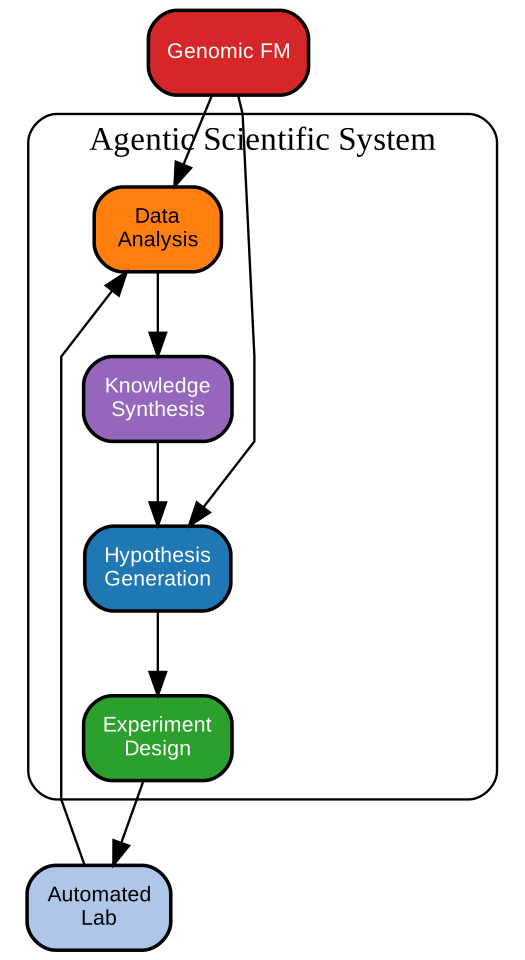
Foundation models have traditionally operated as passive tools: given an input, they produce an output, and humans decide what to do with it. Emerging agentic architectures allow models to take actions, observe outcomes, and adapt behavior based on feedback. In genomic contexts, agentic systems might design experiments, interpret results, revise hypotheses, and iterate toward biological goals with minimal human intervention.
Closed-loop systems couple computational prediction with experimental validation in automated cycles. A design model proposes sequences optimized for a target function. An automated synthesis and screening platform tests proposed sequences. Results feed back to update the model or guide subsequent proposals. Such systems can explore sequence space far more efficiently than sequential human-directed experimentation, as discussed in the design-build-test-learn cycles of Section 31.6.
Agentic systems raise governance questions absent from traditional models:
- Objective specification: How do we ensure the optimization objective captures what we actually want?
- Monitoring and oversight: How do we detect when the system pursues unintended goals?
- Stopping criteria: When should autonomous operation halt for human review?
- Accountability: When an autonomous system makes an error, who is responsible?
- Dual use: How do we prevent agentic systems from being misused for harmful purposes?
These questions connect to the biosecurity considerations in Section 27.6 and require governance frameworks that evolve with technical capabilities.
The promise of agentic and closed-loop approaches is accelerated discovery: identifying functional sequences, characterizing biological mechanisms, and optimizing therapeutic candidates faster than traditional workflows. The risks include models pursuing objectives that diverge from human intent, experimental systems generating safety hazards, and accountability gaps when autonomous systems make consequential errors. Realizing benefits while managing risks requires careful attention to objective specification, monitoring and oversight mechanisms, and safety boundaries that constrain autonomous action.
Large language models trained on scientific text provide complementary capabilities to sequence-based foundation models. Zhang et al. (2024) survey scientific LLMs that can retrieve literature, answer domain questions, and assist with experimental design. Integration of scientific LLMs with genomic foundation models represents a frontier where natural language understanding meets biological sequence analysis, though accuracy on specialized genomic questions varies substantially and requires careful validation for research applications.
32.2.3 Clinical Integration and Learning Health Systems
The ultimate test of genomic foundation models is whether they improve health outcomes. Moving from research demonstrations to clinical impact requires integration into care workflows, evidence of benefit from prospective studies, regulatory clearance, and sustainable business models that support ongoing development and maintenance.
Learning health systems provide a framework for continuous improvement: clinical use generates data that feeds back into model refinement, creating virtuous cycles where models improve as they serve more patients. The virtuous cycle works because clinical deployment reveals failure modes invisible in research datasets: patients with rare phenotypes, populations underrepresented in training data, and edge cases that benchmarks miss all surface during real-world use. Each model prediction becomes a natural experiment whose outcome can inform future predictions. However, such systems raise governance questions about who controls the learning process, how improvements are validated before deployment, and how benefits and risks are distributed across patients, providers, and technology developers.
The foundation model paradigm offers particular advantages for learning health systems. Pretrained models can be adapted to local populations and practices through fine-tuning on institutional data (Section 10.3; Section 13.9.3). Improvements demonstrated at one institution can potentially transfer to others through shared model updates. Common architectures enable comparison across sites and accumulation of evidence across diverse populations.
The Geisinger DiscovEHR program illustrates a learning health system integrating genomic foundation models into clinical care:
Infrastructure: - 250,000+ patients with linked exome sequencing and EHR data - Automated variant classification pipeline incorporating foundation model predictions - Clinical decision support alerts for actionable pharmacogenomic variants - Bidirectional data flow: clinical outcomes feedback to improve models
The learning loop in practice:
Initial deployment (2014): Variant classifier using SIFT/PolyPhen/CADD scores; 23% of rare disease patients received genetic diagnosis
Model update v2 (2018): Added protein language model features (ESM-1); diagnostic yield increased to 31%
Model update v3 (2022): Integrated AlphaMissense and EVE scores; diagnostic yield increased to 38%
Continuous learning: VUS classified by the model but later confirmed pathogenic through clinical outcomes inform model recalibration
Quantitative impact:
| Metric | 2014 Baseline | 2024 After Learning | Improvement |
|---|---|---|---|
| Diagnostic yield (rare disease) | 23% | 38% | +65% |
| Time to diagnosis (median) | 18 months | 6 months | -67% |
| Actionable pharmacogenomic alerts | 2,100/year | 12,400/year | +490% |
| VUS reclassified through outcomes | N/A | Hundreds of variants | N/A |
Key lesson: These VUS reclassifications represent knowledge generated by the health system itself: variants that were uncertain at the time of testing but were clarified by observing patient outcomes. This feedback loop, where clinical deployment generates training data that improves future predictions, is the defining feature of a learning health system.
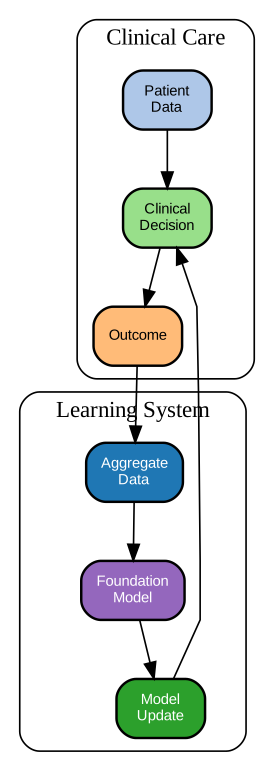
A learning health system is deployed at three hospitals. After six months, Hospital A (large academic center) shows improved outcomes while Hospital B (community hospital) and Hospital C (rural clinic) show no change. What are three possible explanations, and what would you do to investigate?
This scenario illustrates why deployment alone is insufficient without careful monitoring and equity analysis.
Possible explanations: (1) Population differences: Hospital A patients resemble training data better; investigate ancestry and phenotype distributions. (2) Workflow integration: Hospital A integrated the system into clinical workflows effectively while B and C did not; assess actual usage patterns and clinician adoption. (3) Infrastructure and expertise: Hospital A has resources for proper implementation; investigate technical support, training, and data quality. Investigation should include stratified performance analysis, qualitative interviews with clinicians, and equity audits across hospital characteristics.
Realizing this vision requires infrastructure for secure data sharing, governance frameworks that enable learning while protecting privacy, regulatory pathways that accommodate evolving systems, and clinical workflows that support appropriate use and oversight. Technical capabilities alone are necessary but not sufficient. Genomic foundation models will achieve their potential only through sustained collaboration among technologists, clinicians, patients, policymakers, and communities working together to build systems that are both capable and trustworthy.
32.3 Work Ahead
The ultimate test of genomic foundation models is whether they improve health outcomes. The technical capabilities surveyed in the preceding chapters, from sequence representations through foundation model architectures to clinical applications, are necessary but not sufficient for that goal. Between a model that predicts well on benchmarks and a patient whose diagnosis comes faster or whose treatment works better lies the full complexity of clinical translation: validation across populations, integration into workflows, regulatory approval, equitable access, and ongoing monitoring for drift and harm.
Benchmark performance is seductive but insufficient. A variant effect predictor with state-of-the-art AUC may fail to improve clinical outcomes if:
- It performs well on average but poorly for underrepresented populations (Section 13.10)
- Its predictions are uncalibrated and clinicians cannot interpret confidence levels (Section 24.3)
- It flags the same variants that existing tools flag, adding no new information
- It cannot integrate into existing clinical workflows without disruptive changes
- Regulatory uncertainty prevents adoption despite technical merit
Each of these failure modes requires different solutions: technical, organizational, regulatory, or social.
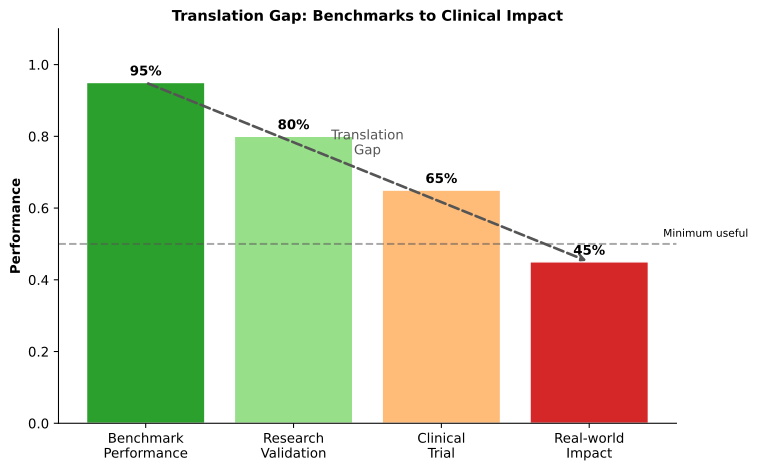
Learning health systems provide a framework for bridging this gap: clinical use generates data that feeds back into model refinement, creating virtuous cycles where models improve as they serve more patients. Such systems raise governance questions as important as the technical ones. Who controls the learning process? How are improvements validated before deployment? How are benefits and risks distributed across patients, providers, and technology developers? How do we ensure that populations underrepresented in training data are not further disadvantaged by systems that learn primarily from others?
As you finish this book, consider: What is the most important problem in your domain that genomic foundation models could help solve? What would success look like? What are the barriers (technical, regulatory, social, or economic) between current capabilities and that success? This reflection can guide your next steps, whether in research, clinical application, or policy.
This final exercise challenges you to synthesize concepts across chapters. Each level adds complexity; attempt them in order.
Level 1 (Single problem): A variant classifier trained on ClinVar achieves 0.89 AUC but performs at 0.72 for African-ancestry patients. Which open problem from this chapter does this illustrate, and what chapter provides specific mitigation strategies?
This illustrates domain shift within the scaling/efficiency challenge (training data bias) and the translation gap (equity failures). Mitigation: Section 10.5 for domain-adaptive fine-tuning; Chapter 13 for detecting ancestry confounding; Section 13.2.1 for multi-ancestry approaches.
Level 2 (Intersecting problems): Your lab develops a model predicting drug response from tumor transcriptomics (AUC 0.85). A pharma partner wants to deploy it for patient stratification, but FDA requires understanding why certain patients respond. The model uses attention over 5,000 genes. Which TWO open problems intersect here, and what approaches from earlier chapters might address both?
Two intersecting problems: (1) Causality - FDA wants mechanistic understanding, but the model captures correlation between expression patterns and response, not causal mechanisms. (2) Multi-scale integration - attention over genes does not explain how genetic variants → expression changes → drug metabolism → response. Approaches: Chapter 25 for attention visualization and ISM; Section 26.2.2 for causal gene identification; structured integration with known drug metabolism pathways might satisfy regulatory requirements.
Level 3 (System-level synthesis): Design a learning health system for pediatric rare disease diagnosis. You have access to a DNA language model, protein structure predictor, and phenotype embeddings. The system must: (a) improve over time, (b) work across 15 hospitals with different populations, (c) handle the translation gap. Identify which components from Parts II-VI you would integrate, which open problems pose the greatest barriers, and what governance structures (from Chapter 27) you would need.
Components needed: - DNA-LM + protein predictor for variant scoring (Chapter 16, Chapter 18) - Phenotype embeddings for HPO matching (Section 28.4) - Uncertainty quantification for VUS flagging (Section 24.8) - Federated learning for multi-site training (Section 10.6.3)
Greatest barriers (open problems): - Multi-scale integration: Phenotype ↔︎ gene ↔︎ variant links require explicit causal structure - Domain shift: Pediatric populations differ from adult-dominated training data; rare disease by definition has minimal training examples per condition - Causality: Parents need to understand why a variant is pathogenic, not just a score
Governance structures: - Tiered consent for learning loop (Section 27.2.1) - Equity monitoring across hospital populations (Section 27.5.2) - FDA breakthrough device pathway for evolving system (Section 27.1.4) - Data governance committee with patient/family representation
This synthesis requires integrating 8+ chapters: the hallmark of systems-level thinking for genomic foundation model deployment.
Genomic foundation models will achieve their potential only through sustained collaboration among technologists, clinicians, patients, policymakers, and communities working together to build systems that are both capable and trustworthy. Capability without trustworthiness is dangerous: models that predict accurately but fail silently for certain populations cause harm even as they help others. Trustworthiness without capability is insufficient: systems that are transparent and fair but do not improve on existing practice offer nothing worth adopting. Technical achievements in genomic deep learning enable new capabilities; the human systems that govern their development and deployment will determine whether those capabilities translate into genuine benefit for the patients and populations that genomic medicine aims to serve.
Before reviewing the summary, test your recall:
- What are the three major open technical challenges limiting genomic foundation model impact? For each, explain why it remains unsolved.
- Why might scaling laws from language models not directly transfer to genomic applications? What biological properties make genomic sequences different?
- Describe how a learning health system would work with genomic foundation models. What are the key governance challenges this raises?
- What is the translation gap between benchmark performance and clinical impact? Give three specific barriers that a high-performing model might face in deployment.
Three major technical challenges: (1) Scaling and efficiency - genomic models remain smaller than language models due to limited training data (only ~100k species with assemblies), prohibitive compute costs ($10M+ for trillion-parameter models), and quadratic attention costs that limit context windows needed for regulatory elements spanning hundreds of kilobases. (2) Multi-scale integration - biological phenomena span nucleotides to organisms, but current models focus on single scales and lack architectures that explicitly integrate across qualitatively different rules at each level (motif detection requires different structures than cell-state modeling). (3) Causality and mechanism - foundation models learn statistical associations rather than causal relationships, but training data is predominantly observational rather than interventional, making it difficult to distinguish true causal variants from those merely in linkage disequilibrium.
Scaling laws and genomic sequences: Language model scaling laws may not transfer to genomics because genomic sequences have fundamentally different statistical properties including lower entropy, stronger long-range dependencies (regulatory elements acting across kilobases), and reverse-complement symmetry constraints absent in natural language. Additionally, biological function imposes constraints that mean memorizing more genome sequence does not automatically improve variant effect prediction or regulatory understanding; the key question is what specific capabilities emerge at what scale for which particular tasks, not simply “how big.”
Learning health systems: In a learning health system, clinical use of genomic foundation models generates data (predictions, treatment decisions, outcomes) that feeds back to refine the models, creating virtuous cycles where models improve as they serve more patients. Clinical deployment reveals failure modes invisible in research datasets such as rare phenotypes, underrepresented populations, and edge cases. Key governance challenges include: who controls the learning process, how improvements are validated before deployment, how benefits and risks are distributed across stakeholders, ensuring populations underrepresented in training data are not further disadvantaged, maintaining consent compliance, and establishing regulatory pathways that accommodate evolving systems while protecting patient safety.
Translation gap barriers: The gap between benchmark performance and clinical impact encompasses multiple barriers beyond technical capability. Three specific barriers a high-performing model might face: (1) Population-specific failures - model performs well on average but poorly for underrepresented ancestries, violating fairness requirements even with strong AUC metrics. (2) Uncalibrated predictions - model has high discrimination but poor calibration, so clinicians cannot interpret confidence levels appropriately for decision-making. (3) Workflow integration challenges - model requires data formats or computational infrastructure incompatible with existing clinical systems, preventing adoption despite technical merit. Other barriers include regulatory uncertainty preventing adoption, adding no incremental information beyond existing tools, and inability to explain predictions in ways clinicians trust.
Core Concepts:
- Open technical problems: Scaling (data, compute, context length), multi-scale integration (nucleotide to organism), and causality (distinguishing correlation from mechanism) remain fundamental challenges
- Emerging directions: Multimodal architectures, agentic systems, and learning health systems each offer promise alongside new governance challenges
- Translation gap: Benchmark performance is necessary but insufficient; clinical impact requires validation, workflow integration, regulatory approval, and equitable access
Key Connections:
- Scaling challenges connect to architectural choices (Chapter 7) and efficiency techniques (Appendix B)
- Multi-scale integration builds on single-cell (Chapter 20), 3D genome (Chapter 21), and network approaches (Chapter 22)
- Causality challenges extend the discussion from Chapter 26
- Governance requirements connect to Chapter 27 and responsible development practices
Looking Forward:
The field stands at an inflection point. Technical capabilities have advanced dramatically, but realizing clinical impact requires progress on multiple fronts simultaneously: not just better models, but better evaluation, better integration, better governance, and better collaboration across disciplines. The work ahead is not just technical; it is fundamentally human.
Further Reading: